GUIDEPOSTS
What Is Dock Fouling? A Look Beneath the Docks at Coastal Expeditions Summer Camp
Walk down almost any dock on the South Carolina coast and you’ll see plenty happening above the water—boats coming and going, fiddler crabs scurrying along the marsh edge, pelicans flying overhead. But some of the most interesting wildlife is hiding underneath.
At Coastal Expeditions Outdoor School, one of our favorite summer camp activities is something we call dock fouling. Basically, we lie down on the dock, peer underneath and see what has decided to make a home there.
It’s a little slimy. Usually surprising. And almost always a hit with kids.
What Is Dock Fouling?
In marine science, “fouling” refers to the community of organisms that grows on submerged surfaces like docks, pilings, boat bottoms, ropes and buoys. But dock fouling is also a little like crabbing. It’s the name we use for the activity itself:
grabbing a dip net, getting down on the dock and seeing what we can find. If you’ve ever looked underneath a floating dock and seen oysters, barnacles, algae and strange squishy things clinging to it, you’ve seen a fouling community.
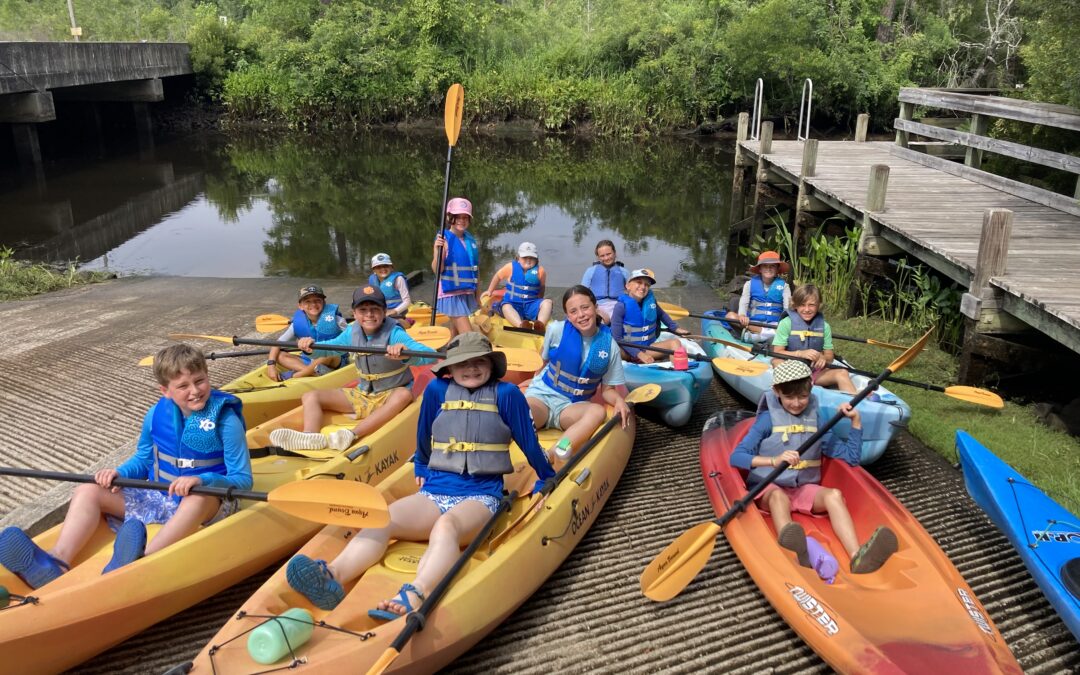
At our Outdoor School camps in Charleston and Beaufort, we give kids a chance to investigate that community up close. Campers lie on their bellies, reach underneath with dip nets and carefully collect some of what’s growing there so we can take a closer look. And that’s when an ordinary dock starts getting really interesting.
Depending on the season and location, we might discover barnacles, juvenile oysters, sea squirts, bryozoans, tiny crabs, worms, shrimp, algae and plenty of things that make everyone ask:
What is that?
One sea squirt we may encounter is Botryllus violaceus, a colonial tunicate found growing on docks and other submerged surfaces along the East Coast. But knowing the scientific name isn’t really the point.
The fun starts with finding it.
Is Dock Fouling the Same as Biofouling?
Pretty much—although biofouling is the broader scientific term.
Marine biofouling happens when organisms like algae, barnacles, oysters, mussels and tunicates settle and grow on surfaces that stay underwater. It happens on docks, but it also happens on boat hulls, ropes, buoys, scientific equipment and all kinds of other submerged surfaces.
A dock fouling community is simply one example of marine biofouling—and a particularly good one for kids to explore because it’s right there within reach.
Scientists and boat owners may think about biofouling in terms of managing what’s growing on underwater equipment or boat hulls.
We get to look at it differently
For us, what’s growing under the dock is an ecosystem waiting to be discovered
A Living Science Experiment
One of the things we love about dock fouling is that there isn’t a predetermined outcome. It’s real field science.
What we find in June may look completely different from what we discover in August. What’s living beneath a dock on Shem Creek may be different from what we find around St. Helena Island.
And nobody hands the kids a sheet telling them exactly what they’re supposed to find.
Instead, they get to do what naturalists and marine scientists actually do: observe, compare, ask questions and look more closely.
“Why are there so many barnacles?”
“What is that squishy thing?”
“Is it an animal or a plant?”
“What eats it?”
“Why did this organism settle here?”
And, inevitably:
“Can I touch it?”
That’s usually when the fun really begins.
Why We Use Dock Fouling at Our Outdoor Summer Camps
We want Coastal Expeditions summer camps to be more than a list of activities that keeps kids busy until pickup.
We want kids to become comfortable outside—and curious about the Lowcountry around them.
Dock fouling is particularly good at that because it takes something completely ordinary, a dock they’ve probably walked across dozens of times, and changes the way they see it.
A piling isn’t just holding up a dock anymore. It’s habitat.
A clump of oysters isn’t just a collection of shells. It’s shelter.
And even the slimy stuff deserves a closer look.
This kind of hands-on exploration is a big part of our approach to outdoor education in Charleston and Beaufort. Instead of simply telling kids about an estuary, we want them standing beside one, reaching into it and figuring out what’s living there.
Learning to Look Closer
Kids are naturally good field scientists when we give them the opportunity.
They notice tiny things. They ask questions adults don’t think to ask. And they’re generally much less bothered than adults by mud, slime and creatures with an excessive number of legs.
That’s one of my favorite things about activities like dock fouling.
Once a child realizes that an entire community of animals can be living underneath a dock, there’s a pretty good chance they’ll look underneath the next one, too.
Learning the names of organisms is wonderful. Understanding concepts like habitat, biodiversity and estuarine ecology matters, too.
But we’re also teaching something much simpler:
Pay attention.
Look underneath things. Notice what’s changing. Ask why something is there. Get curious about the place where you live.
That’s where a lifelong relationship with the outdoors often begins.
Summer Camp in Charleston and Beaufort Is Better Outside
Dock fouling is just one of the ways kids explore the Lowcountry during Coastal Expeditions Outdoor School programs.
Depending on their age, camp and location, they may spend their days kayaking, fishing, crabbing, exploring salt marshes, learning outdoor skills, looking for fossils, identifying wildlife and getting sandy, muddy and wet.
Our outdoor summer camps in Charleston and Beaufort are designed around the places where we live. The salt marshes, tidal creeks, maritime forests and estuaries aren’t scenery for camp.
They’re the classroom.
And sometimes one of the best lessons of the day is hanging underneath the dock.
MORE TO EXPLORE
What is dock fouling?
Dock fouling refers to the community of marine organisms that grows on submerged docks and pilings. At Coastal Expeditions Outdoor School, “dock fouling” is also what we call the hands-on activity of using dip nets to investigate what’s living underneath our docks.
Is dock fouling the same thing as biofouling?
Dock fouling is a type of marine biofouling. Biofouling is the broader term for organisms growing on submerged surfaces such as docks, boats, ropes, buoys and marine equipment.
When are Coastal Expeditions Outdoor School programs offered?
Coastal Expeditions Outdoor School offers programs throughout the year, including summer camps, after-school programs, homeschool expeditions and school field trips.
Where does Coastal Expeditions offer Outdoor School programs?
Our Outdoor School programs explore some of the best outdoor classrooms in the Lowcountry, including Shem Creek, Cape Romain National Wildlife Refuge and Daniel Island in the Charleston area, as well as St. Helena Island near Beaufort, South Carolina.
How long has Coastal Expeditions offered summer camps and programs for kids?
Coastal Expeditions owner Chris Crolley started our first summer camp on Shem Creek in 1995. Since then, our education programs have grown to include summer camps, field trips, after-school programs, homeschool expeditions and paid internships for high school and college students.
Where can I sign up for Coastal Expeditions Outdoor School programs?
Current camps, classes and Outdoor School programs can be found on the Coastal Expeditions website.