GUIDEPOSTS
Fall Wildflowers on the Blackwater Creeks
There is a moment every fall when the Blackwater creeks begin to glow.
The water is still dark with tannins, the cypress trees still hold much of their green, and the afternoon can feel more like summer than autumn. But along the old rice-field banks, where the sun reaches all the way to the ground, the wildflowers tell us that the season has changed.
This is one of the great surprises of exploring the ACE Basin in fall. Everyone expects the birds. They come looking for the movement of migration, for the first returning waterfowl, for an eagle crossing the sky. What they may not expect is a wildflower garden spilling down the banks beside the creeks.
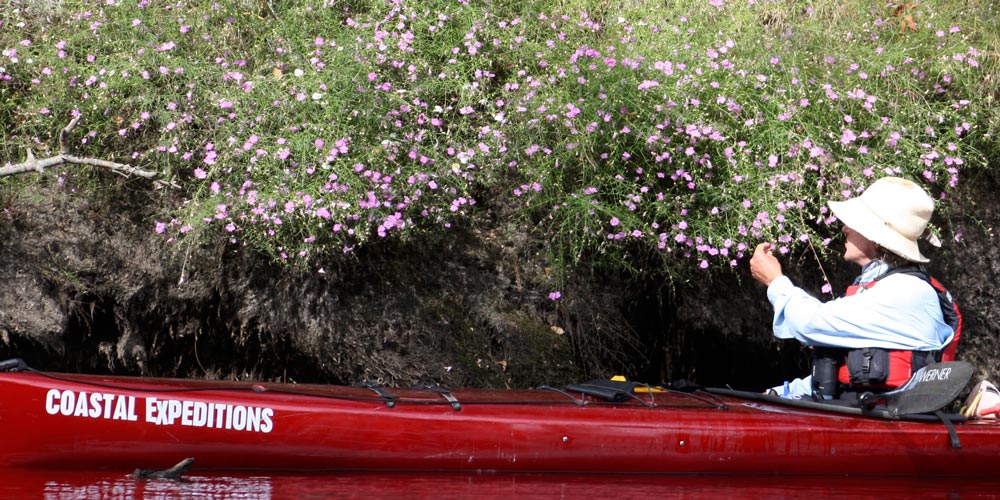
These plants are not arranged in tidy beds. They climb, trail, ramble, lean, and reach. Morning glories thread their trumpets through the vegetation. Mallows open soft hibiscus-like flowers to the sun. Climbing hempvine, groundnut, passionflower, wild beans, and other late-season vines wind themselves through grasses and shrubs. Smartweeds brighten the damp edges, while goldenrods and asters begin announcing the coming of cooler weather.
The old rice fields make this display possible. Their embankments and dikes create long ribbons of open habitat between forest and water. Sunlight pours onto places that would otherwise be shaded beneath the swamp canopy. Add moisture, disturbed soil, and the astonishing botanical abundance of the Coastal Plain, and those narrow banks become elevated wildflower corridors.
From a boat, the effect can be magical. Against the dark creek water, every flower seems brighter.

Meet the Perennial Wild Bean
One of my favorite discoveries along these banks is Strophostyles umbellata, commonly called perennial wild bean, pink wild bean, or pink fuzzybean.
It belongs to the pea family, Fabaceae, something you can see immediately in the shape of its flowers. Each bloom looks like a tiny sweet pea, usually rose-pink to pale purple, held above a slender vine with three-part leaves. It is native to fields, woodland edges, clearings, and other sunny habitats across much of the southeastern and central United States.
It is not a plant most people know by name. That is part of its charm.
Perennial wild bean does not arrive with the instant recognition of a sunflower or morning glory. You notice a small pink bloom tucked among the vines, lean closer, and realize you have found something entirely new—or at least new to you. Once you learn it, another piece of the landscape comes into focus.
The plant trails or twines through surrounding vegetation and blooms from summer into early fall. Later, it produces narrow beanlike pods. The “perennial” in its common name distinguishes it from some of its close relatives and hints at the unseen root system that allows it to return.
It is a joyful little native: modest, beautiful, and perfectly at home in the loose, sunlit community growing along the old rice-field banks.
These less-famous species remind us how much life exists beyond the handful of plants we were taught to recognize. A wild bank that first appears to be simply “green” becomes, with attention, a gathering of individuals—each with a name, a history, and a relationship to this particular place.

Where Three Rivers Meet the Sea
The ACE Basin takes its name from the Ashepoo, Combahee, and Edisto rivers. Together, these rivers flow through one of the largest relatively undeveloped estuarine landscapes remaining on the Atlantic Coast.
Fresh water, blackwater creeks, tidal rivers, salt marshes, forested wetlands, pine uplands, agricultural fields, and historic rice impoundments meet here. The result is not one habitat but a vast, interconnected mosaic. What happens in the woods matters to the marsh. What grows on the banks supports insects, birds, and other wildlife. What the tides carry into an impoundment becomes part of a food web that stretches from tiny invertebrates to wading birds and bald eagles.
The rice fields also hold a difficult human history. Their earthworks were built and cultivated through the knowledge and forced labor of enslaved Africans and their descendants. Today, many of these former fields are managed as wetlands, but the landscape still carries the marks—and the stories—of the people who shaped them. To experience the ACE Basin fully is to hold its beauty and its history together.
Fall reveals the scale of this place especially well. The air begins to clear. The light drops lower. The marsh takes on bronze and gold. Birds traveling the Atlantic Flyway move through in waves, using the Basin’s forests, fields, creeks, mudflats, and wetlands to rest and feed.
Some migrants are passing through. Others are arriving for the winter. Bald eagles become increasingly conspicuous as nesting season approaches and pairs turn their attention again toward territories and nests. Hawks begin sweeping low over the marshes. Ducks gather on managed wetlands. Shorebirds work the exposed edges, while warblers and other songbirds slip through the vegetation during the height of fall migration.
And beneath all that movement in the sky, the flowers are still blooming.
Slow Down
A fall day in the ACE Basin should not be rushed.
Out on the water, slow down. Let the kayak drift beside the banks. Look beyond the largest or brightest flowers. Search among the morning glory vines for the pink face of perennial wild bean. Watch butterflies and bees working the last generous blooms of the warm season. Listen for the calls overhead. Scan the tall pines for the unmistakable shape of an eagle.
There is a wonderful overlap happening here. Summer has not quite let go, but fall migration is fully underway. Flowers that waited through the heat are finally having their moment, even as birds from hundreds or thousands of miles away arrive above them.
This is the unexpected wildflower experience of our Blackwater creeks. It is another reason fall may be the most extraordinary time to be in the ACE Basin.
The ACE has often been described as one of Earth’s last great places. That sounds enormous—and it is—but such places reveal themselves through very small encounters: a pink wild bean on a sunny bank, an eagle circling above an old rice field, a morning glory reflected in black water.
MORE TO EXPLORE
Do I need kayaking experience to do an ACE Basin Blackwater Tour with Coastal Expeditions?
No, we provide all the gear and instruction to make for a great day on the water. We time the tour with the tides so that the flow of water gives us an extra assist. Just dress for the day, pack a bagged lunch and come on!
What wildlife will we see on an ACE Basin kayak tour?
The wildlife opportunities change with each season, but this region is rich with diversity. We often see wild turkeys, whitetail deer, bald eagles, alligators, ospreys, migratory waterfowl and passerines like painted buntings and prothonotary warblers. From the spring to fall, wildflowers bloom along the rice banks attracting butterflies and other pollinators. Sometimes we even see dolphins in the brackish areas!
Do the Coastal Expeditions guides have training in safety and first aid?
Every year, Coastal Expeditions guides receive continuing education in first aid, CPR, life guarding and ACA kayaking. On every tour, safety is paramount.
What is the ACE Basin?
The ACE Basin is a vast, largely undeveloped estuarine landscape formed by the Ashepoo, Combahee, and Edisto rivers in South Carolina’s Lowcountry. Its blackwater creeks, tidal marshes, forests, and historic rice fields provide extraordinary habitat for wildflowers, migratory birds, bald eagles, alligators, and countless other native species.